3D Virtual Tour vs. Photos: When Does a Listing Need Both?
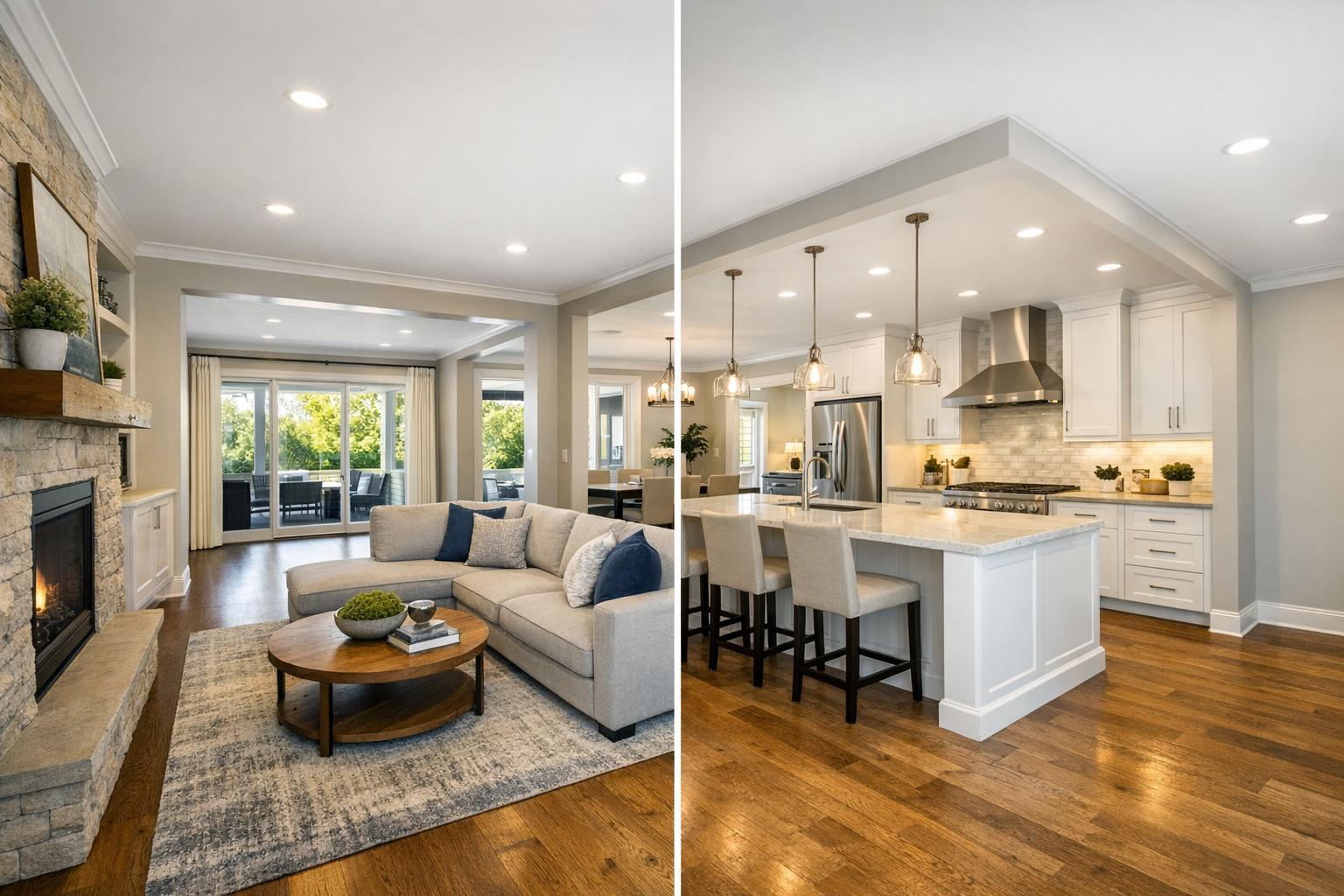
A spacious, modern open-plan living room and kitchen with hardwood floors and elegant furnishings is showcased, inviting exploration through a 3D virtual tour.
3D Virtual Tour vs. Photos: When Does a Listing Need Both?
A 3d virtual tour can transform how a listing is experienced, but it serves a different purpose than classic property photos. As real estate media producers working in NYC, New Jersey, and the surrounding market, we see first-hand how each tool plays its own role—photos shape a first impression, while an immersive property walkthrough lets viewers explore on their own terms.
For many listings, professional photography is the absolute minimum. Well-lit, thoughtfully composed photos allow buyers, renters, and decision makers to immediately see what stands out: sunlight streaming through large windows, the modern feel of a recent renovation, a unique brownstone staircase, a skyline view. But once a buyer or tenant takes early notice (often in a matter of seconds), the next natural question is: “How does this place actually fit together?”
This is where a 3d virtual tour comes in. Rather than flipping through a series of stills, the viewer gains the freedom to step through rooms, retrace hallways, and map out space in their own mind—a step that’s especially practical when floor plans are complex, property layouts are unique, or your audience may be remote. And most of the time, it isn’t about choosing one or the other. The right plan often means both, for listings where space, scale, or room flow makes that extra context meaningful.
Why Photos and Tours Offer Different Value
Let’s start with how people discover properties. Online galleries, social posts, and listing platforms all rely on photos—those gallery shots set expectations, highlight feature rooms, and help agents control what’s shown first. Good photos have purpose, calling out the focal points an owner or agent wants seen.
By contrast, a Matterport tour or similar 3D capture hands the experience to the viewer. They decide where to go, what to focus on, and how deeply to dig. Maybe they want to see if the primary bedroom really connects to the deck, check a home office’s separation from living areas, or walk a commercial space “from the front door to the back”—all questions that a traditional gallery can struggle to answer without a full context shot.
Here’s how each format tends to fit:
- Photos capture beauty, light, finishes, and detail fast, and can be used in nearly all digital and print marketing assets.
- Interactive tours empower viewers to investigate, replay, and “walk” the space at their pace.
- Photos let you choose the most attractive angle (which is a production decision in itself).
- Tours clarify connections: not just what a room looks like, but how you get from one space to another.
- Photos are quick to scan; tours help hesitant or remote viewers “preview” before visiting.
In most listings where layout or spatial relationships could affect interest or price, pairing high-quality photos with a 3d virtual tour gives both a quick overview and a deep dive.
What an Immersive Property Walkthrough Makes Clear
No matter how many galleries you include, photos require viewers to mentally reconstruct the space. Even the best images (professionally composed, carefully edited, with verticals correct and window light handled) may leave people asking: “Is the kitchen really open to the dining room?” “Are the bedrooms split or together?” “How do I get to the terrace?”
A Matterport tour or similar walkthrough can answer these common questions:
- Which rooms connect directly?
- Does the second floor link by an open staircase or closed hallway?
- Where is the laundry, storage, or added room?
- What’s the separation between public and private zones?
- In a commercial suite, is it open-plan, or are there several offices around a reception core?
This is particularly crucial for homes with multiple levels or additions, Manhattan apartments with quirky layouts, Brooklyn brownstones with parlor floors and garden access, and New Jersey homes where a finished basement or bonus room might not be obvious in photos. The goal isn’t to give every answer, but to invite better and more informed questions before anyone steps inside for a showing.
When Both Are Useful: Property Types That Benefit
Some listings genuinely need only photos and a simple floor plan—think compact studios, straightforward condos, or any property with an easily understood layout. In our experience, these scenarios are the exception, not the rule, in NYC and NJ. Here’s where a tour adds significant value:
Manhattan Apartments: Context for Unique Layouts
Manhattan properties are often defined by architectural details, ceiling height, or a dramatic view: these shine in photos. But when an apartment’s entry, room connections, or proportions are unusual, a 3D virtual tour makes it easier for out-of-town buyers or busy renters to understand what’s unique—without having to schedule a visit just to answer basic questions about flow.
Brooklyn Brownstones and Multi-Level Homes
Vertical flow is nearly impossible to communicate with photos alone. Capturing the journey from parlor to kitchen, bedrooms, garden, and lower levels reveals how a property actually lives—especially when a single floor plan can’t explain quirks or additions. The tour becomes the “connective tissue” that lets a buyer trace their own path, while the photo set showcases the property’s character and finishes.
New Jersey Homes, Larger Spaces, or Additions
Multi-story homes in New Jersey, especially those with finished basements, additions, or separate wings, benefit from a virtual walkthrough. Spatial relationships that seem simple on paper become clearer when a viewer can “move” between levels and see the connections for themselves.
New Developments and Model Units
Photos are designed to show off finishes, fixtures, and design intent. For new developments or model apartments, a Matterport tour lets clients explore a representative unit, see amenities, and decide if a particular configuration works. It’s helpful for out-of-area buyers or tenants and for teams who want to make early exploration as easy as possible.
Remote Rental Audiences
For rental units—especially in busy or expensive markets where out-of-state decisions are common—a tour can speed up the process. Serious prospects move quickly: photos catch the eye, but a tour lets them screen for must-have features, storage, or work-from-home options.
Commercial Spaces Needing Circulation Clarity
Retail, office, or mixed-use listings where movement, sightlines, or space planning matter almost always benefit from a virtual tour. Showing how offices, conference rooms, entrances, and back-of-house spaces fit together is easier for a prospective tenant or business owner to decipher in an interactive format—while professional photos convey light, finish quality, and outward appeal.
When Photos and Floor Plans Are Sufficient
3D virtual tours are not always necessary. For some listings, especially small, uncomplicated spaces, photos and a clear floor plan do the job:
- The property is compact or has a standard, easy-to-scan layout.
- Most decisions will be made after a quick glance at gallery photos.
- Budgets need to be tightly focused on photography or another listing priority.
- The property is heavily occupied, making uninterrupted 3D capture challenging.
- There’s minimal visual or spatial complexity.
A well-produced floor plan answers questions about room placement and size from a top-down view. Combined with polished photography, it gives viewers enough context for basic decision-making. Tours, however, remain unmatched for explaining the “flow” of spaces.
Practical Considerations for 3D Tour Capture
Producing a usable 3d virtual tour requires physical, on-site scanning of the actual property—it can’t be reconstructed from past photos, PDFs, or architectural plans. This is an important distinction for listings with recent renovations, new layouts, or unique combinations.
When preparing a property for a Matterport or other 3D tour, you’ll need to plan for:
- Decluttering main rooms, surfaces, and hallways to avoid distractions.
- Removing personal items that shouldn’t be visible.
- Confirming all areas (rooms, terraces, basements, and outdoor space) are accessible.
- Handling building or suite access, elevator details, and entry instructions (especially in NYC buildings).
- Turning on lights and opening blinds for consistent exposure.
- Deciding in advance which spaces are included in the scan.
Clutter or last-minute changes are harder to “work around” in interactive tours than in single images, since viewers can move through every part of the space. With RealtaSnap, 2D floor plans can also be captured on-site as an add-on service when ordered with a tour.
Service Area, Booking, and Pricing
RealtaSnap offers on-site 3d virtual tour capture throughout NYC, New Jersey, and select areas in Westchester and Upstate New York. All tours are produced from physical visits—not existing media. 3D tour pricing is $199 for properties up to 3,000 square feet and $299 for spaces between 3,001 and 6,000 square feet. Optional add-ons include 2D floor plans and hosting transfer if needed.
When booking, provide at least 24 hours’ notice, share property access instructions, and select your desired media bundle using the online calendar. Orders can be scheduled quickly to fit your timeline, and all critical preparation info is available before your appointment.
A Strategic Approach to Media Planning
There’s no “one size fits all” for listing media. When deciding whether to add a 3d virtual tour, focus on the property’s unique communication challenges. For visually appealing spaces with intuitive layouts, sticking to photography makes sense. When room relationships become important—but you don’t need a full walkthrough—photos with a floor plan may be most efficient. In cases where layout, flow, or remote decision-making matter, photos plus a 3D tour (and, for complex properties, an on-site floor plan as well) can save everyone time, reduce confusion, and equip your audience to make a more informed call.
No amount of media can guarantee results, but the right package—tailored to the actual space and how viewers interact with listings in NYC and NJ—will always help people see your property clearly.
For more details or to set up a walkthrough, visit www.RealtaSnap.com.
FAQ
Question: Can you create a 3D virtual tour without visiting the property in person?
Answer: No. A true 3d virtual tour requires on-site scanning of the real space; it cannot be built from listing photos, floor plans, or architectural drawings.
Question: Should I order a 2D floor plan with my Matterport or 3D tour?
Answer: It depends. If layout is crucial—for instance, with multi-level homes, townhouses, or commercial suites—a 2D plan adds a helpful overview to complement the interactive tour. Both are captured on-site and provide different types of clarity for potential buyers or tenants.
Question: How do I book a tour and what’s needed before the appointment?
Answer: Booking is handled online at www.RealtaSnap.com. You’ll need to share property access details, which rooms will be included, and any special instructions. Preparing the space so all rooms are accessible and tidy makes for the best possible experience in the final tour.